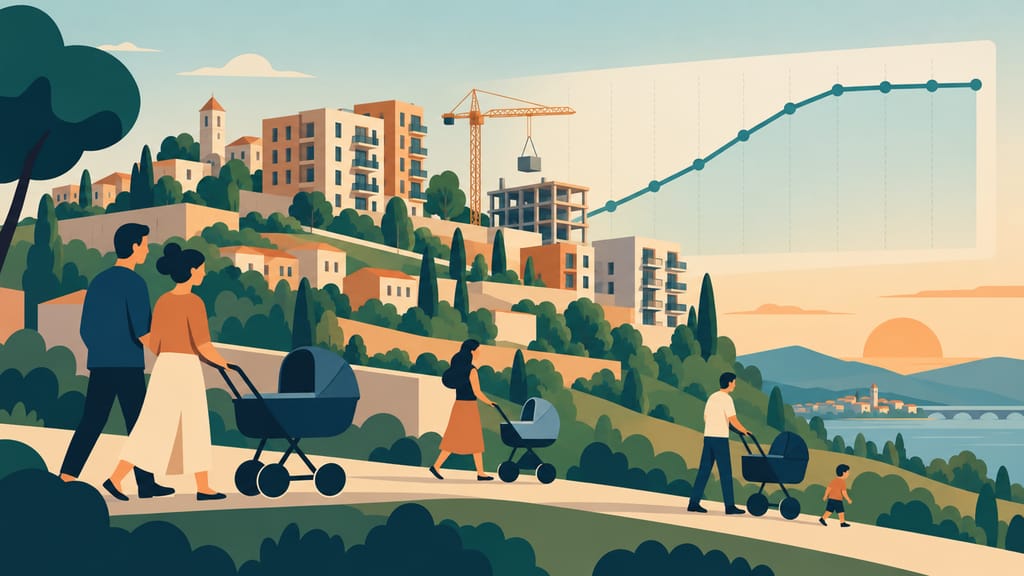
Harish remains one of Israel's fastest-growing cities, but the source of that growth is changing, according to the Central Bureau of Statistics' local-authorities file for 2024, reported on 22 July 2026 by the Hebrew-language outlet Harish City.
The city had 41,574 residents at the end of 2024, up from 39,001 a year earlier. The 4.68 percent growth rate is about four times the national 1.14 percent and third among Israeli municipalities, behind Be'er Yaakov (7.2%) and Netivot (5.6%). It is down sharply from 23.3 percent in 2022 and 7.8 percent in 2023.
Growth now comes from within
In 2024, 3,082 people moved to Harish and 2,114 left, a net internal gain of 968, or 786 including moves abroad. That total migration balance is down about 64 percent from 2,201 in 2023. Meanwhile 1,162 babies were born against 64 deaths, a natural increase of 1,098, now the city's main growth engine.
Only 25 housing starts were recorded in 2024, down from 172 in 2023, with no completions. The lull is expected to last until the Harish South and "Trapez" plans generate the next wave of building.
A young city, with challenges
- 44.5 percent of residents are under 18; the fertility rate is 3.56 children per woman (national: 2.87).
- 10-to-14-year-olds are 9.68 percent of the population (national: 8.63 percent); 15-to-19-year-olds are 4.76 percent (national: 7.92 percent), so demand for teen frameworks is set to climb.
- The dropout rate in grades 7-12 is 2.97 percent (national: 1.71 percent), and 4.16 percent among boys.
- Teachers' average tenure is 9.5 years versus 16.3 nationally.
- The municipality ran a ₪26.1 million deficit on income of about ₪390 million. Just over half of spending went to education. Only 43.3 percent of income was self-generated (average city: 61.2 percent); 56.7 percent came from government grants.
Source: Harish City, "End of the rapid-absorption era: Harish keeps growing, but enters a new phase" (Hebrew), 22 July 2026.