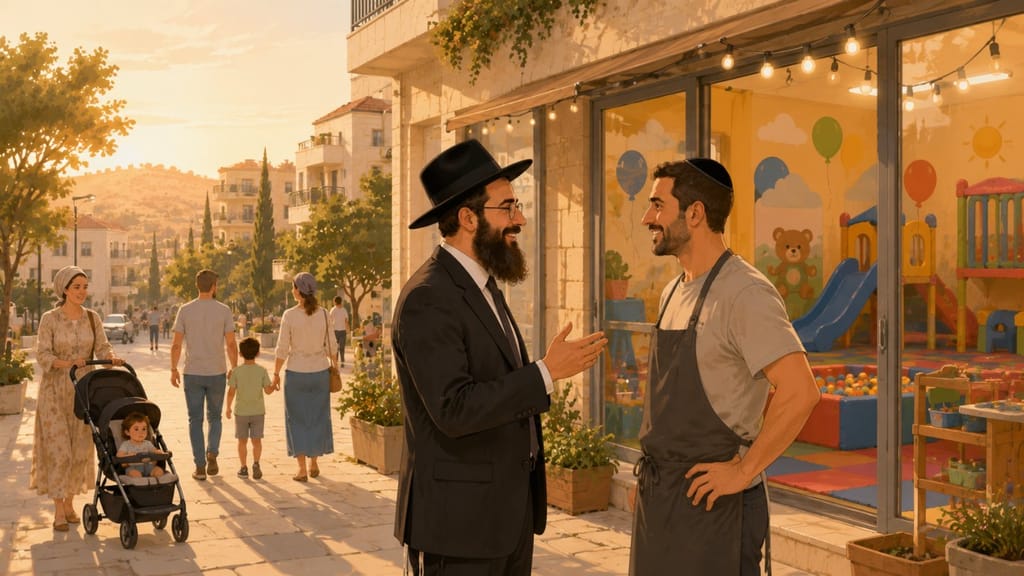
Fifty days after his election as Harish's first city rabbi, Rabbi Asher Zagdon landed in the middle of his first public storm. The High Court of Justice rejected a petition against the process by which he was chosen, leaving his appointment in place — but in the same week, a photograph of him sitting with the owners of the White Pool play center, alongside the business's announcement that it would close on Shabbat, revived fears among some secular residents of a shift in the city's status quo.
In an interview with local outlet Harish City, Zagdon pushed back on that reading of events. He said he had not known the play center's owners, had never visited the business, and was not involved in the decision to close on Shabbat. According to Zagdon, council member David Finkel told him the owner had decided to close and wanted the rabbi to come and give his blessing. "I went there innocently," he said, adding that he did not know the photo would be published or understand the public weight it would carry.
The play center, in the Betzavta neighborhood, was several years ago the focus of a sharp confrontation between secular and Haredi groups in the city. Zagdon says he deliberately stayed out of that fight at the time, and frames his position as a matter of principle: "If a play center operates on Shabbat without disturbing others — what's the problem? I believe in 'live and let live.'"
Following the publication of the photo, opposition leader Shani Grinberg filed a formal information request with the municipality seeking to clarify what role Zagdon and Finkel played in contacts with the business's owners.
On the future municipal country club — which Grinberg warned could be the next front, writing "today the play center, tomorrow the country club" — Zagdon said he does not oppose its operating on Shabbat, pointing to his hometown of Ramat Hasharon, where a country club and municipal pool operate on the day of rest. He suggested separate swimming hours could serve the religious public alongside general operation, but stressed the decision is not his to make: "I am a city rabbi, not a mayor and not an inspector."
Zagdon, who is identified with the Sephardi-Haredi public and was elected with the support of the local coalition and Shas, also addressed a 2019 statement attributed to him describing Harish as a "Haredi stronghold." He said the remark belonged to a different era in the city's planning history, and that his goal today is to serve everyone: residents who want nothing to do with him "won't feel me," while anyone who seeks him out — for a brit, a wedding, or family mediation — will find him obligated to them.
Among his stated priorities: building professional forums for kashrut, mikvaot and family services, improving conditions at the city's mikvaot, and creating a free municipal mehadrin kashrut track that could save business owners hundreds of shekels a month. About 80 food businesses and some 20 kashrut supervisors currently operate in the city.
Source: Harish City — חריש סיטי